Nirmala Erevelles
Professor of Educational Leadership and Foundations of Education, ELPTS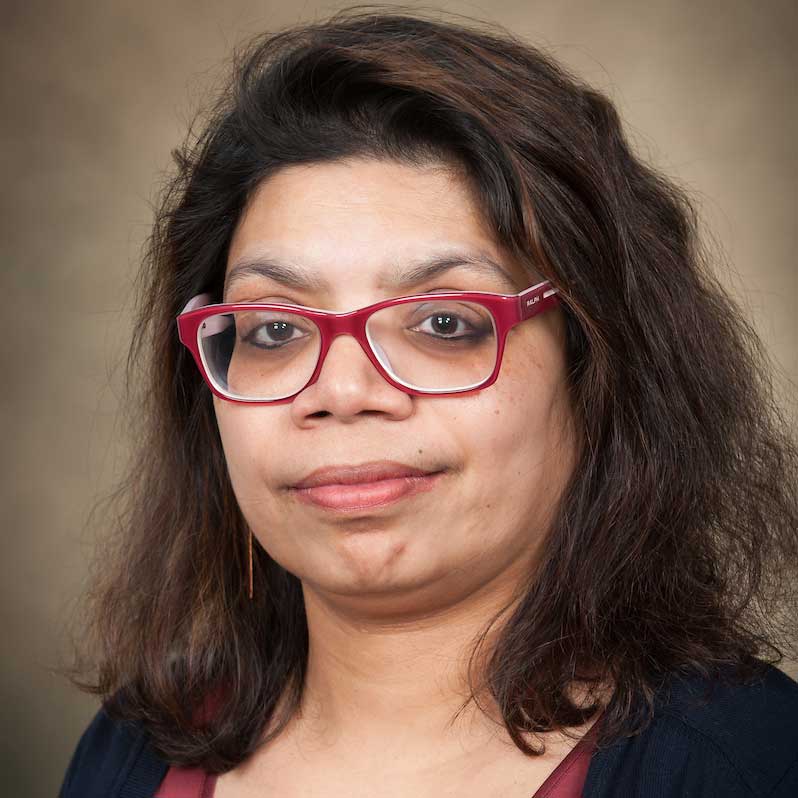

| Degree | Area of Study | University |
|---|---|---|
| Ph.D. | Cultural Foundations of Education | Syracuse University |
| M.S. | Special Education | Syracuse University |
| B.S. | Mathematics | Madras University, India |

| Women’s Studies | Syracuse University |

| Year | Award |
|---|---|
| 2018 | AFRICAN AMERICAN REVIEW’S WEIXLMANN PRIZE for the journal article, “The Absent Presence of Elsie Lacks: Hauntings at the Intersection of Race, Class, Gender, and Disability,” given to the journal’s best essay on 20th- and 21st-century literature |
| 2017 | SENIOR SCHOLAR AWARD, SOCIETY FOR DISABILITY STUDIES |
| 2017 | AMERICAN EDUCATIONAL STUDIES ASSOCIATION (AESA) GEORGE KNELLER LECTURER. Nominated from the membership to give this lecture as an individual recognized for leadership, teaching, and service within the study of the philosophy of education |
| 2016 | PRESIDENT’S FACULTY RESEARCH AWARD, The University of Alabama |
| 2015 | NELLY ROSE MCRORY FACULTY EXCELLENCE AWARD for Exemplary Research in the College of Education, The University of Alabama |
| 2015, 2009 | FINALIST, LAST LECTURE AWARD, Graduate School, The University of Alabama |
| 2012 | AESA’s (American Educational Studies Association) CRITIC’s CHOICE AWARD for the book Disability and Difference in Global Contexts: Towards a Transformative Body Politic. (Palgrave MacMillan) |
| 1998 | OUTSTANDING UNDERGRADUATE TEACHING AWARD, Auburn PanHellenic Council |


Nirmala Erevelles is Professor of Social and Cultural Studies in Education at the University of Alabama. Her research focuses on the unruly, messy, unpredictable and taboo body – a habitual outcast in educational (and social) contexts. Erevelles asks: Why do some bodies matter more than others? In raising this question “why,” the tenor of her scholarship shifts from description to explanation to highlight the implications the exploitative social/economic arrangements have for making bodies matter (or not) in diverse historical and material contexts. Erevelles argues that disability as a central critical analytic can have transformative potential in addressing issues as varied as inclusive schooling, critical/radical pedagogies/curricula, HIV/AIDS education, facilitated communication, school violence, multicultural education, the sex curriculum, and the school-to-prison pipeline. Her insistence on an intersectional analysis foregrounds the dialectical relationship between disability and the other constructs of difference, namely race, class, gender, and sexuality and its brutal implications for (disabled) students in U.S. public schools and (disabled) citizens in transnational contexts. Additionally, transforming her theoretical leanings to committed praxis, she deploys the lens of disability studies to urge her students to think harder, deeper, and more courageously outside the confines of normative modes of education and social theory that only seek to discipline bodies rather than empower them.
Dr. Erevelles’ teaching philosophy follows closely African-American writer James Baldwin’s (1963) argument in his essay, “A Talk to Teachers”:
“The paradox of education is precisely this — that as one begins to become conscious one begins to examine the society in which he is being educated. The purpose of education, finally, is to create in a person the ability to look at the world for himself, to make his own decisions, to say to himself this is black, or this is white, to decide for himself whether there is a God in heaven or not. To ask questions of the universe…. The obligation of anyone who thinks of himself as responsible is to examine society and try to change it and to fight it — at no matter what risk. This is the only hope society has. This is the only way societies change.”