

EDUCATION
| Degree | Area of Study | University |
|---|---|---|
| Ph.D. | Psychology, Faculty of Psychology | University of Barcelona, Spain |
| M.S. | Cognitive Science and Language, Faculty of Psychology | University of Barcelona, Spain |
| B.S. | Psychology, Faculty of Psychology | University of Barcelona, Spain |

AWARDS & HONORS
| Year | Award |
|---|---|
| 2025 | Alabama Life Research Institute (ALRI) fellow, Second Cohort |
| 2014 | Extraordinary Ph.D. Award in Psychology, University of Barcelona |
| 2014 | International Research Stay Fellowship, Spanish Ministry of Science and Innovation |
| 2010-14 | Pre-doctoral Fellowship, Spanish Ministry of Science and Innovation |

AREAS OF EXPERTISE
Mathematical cognition
Educational neuroscience
Neurocognitive mechanisms of arithmetic development
Math anxiety & math attitudes
Functional magnetic resonance imaging (fMRI)
Event-related potentials (ERPs)
Longitudinal neuroimaging

RESEARCH INTERESTS
Dr. Suárez Pellicioni has expertise in mathematical cognition, educational neuroscience, and the neurocognitive mechanisms of arithmetic development. Her work uses behavioral, neuroimaging, psychophysiological, and longitudinal methods to examine how children develop mathematical fluency and why some learners experience difficulties in mathematics.
Her expertise spans functional magnetic resonance imaging, event-related potentials, longitudinal neuroimaging, math anxiety, math attitudes, and individual differences in learning. Through this interdisciplinary approach, she investigates how cognitive, emotional, social, and neural factors shape math performance and development. Her broader work also includes contributions to open science, psychometric measurement, and educational practice.

ACADEMIC & RESEARCH APPOINTMENTS
- Assistant Professor, Department of Educational Studies in Psychology, Research Methodology, and Counseling, The University of Alabama, January 2020–present
- Postdoctoral Research Associate, Brain Development Lab, Department of Psychology and Human Development, Vanderbilt University, August 2017–October 2019
- Postdoctoral Research Associate, Brain Development Lab, Department of Communication Sciences and Disorders, The University of Texas at Austin, November 2015–August 2017
- Visiting Scholar, Human Performance Lab, Department of Psychology, University of Chicago, February 2014–May 2014

SELECTED PUBLICATIONS
- Suárez-Pellicioni, M., Price, G., & Booth, J. R. (2025). The association between longitudinal changes in inter-hemispheric IPS functional connectivity and math gains depends on children’s age and task requirements. Developmental Cognitive Neuroscience, 78, 101666. https://doi.org/10.1016/j.dcn.2025.101666
- Suárez-Pellicioni, M., Demir-Lira, Ö. E., & Booth, J. R. (2024). Positive math attitudes are associated with greater frontal cortex activation to solve large multiplication problems among children from higher socio-economic status families. Neuropsychologia, 194, 108788. https://doi.org/10.1016/j.neuropsychologia.2024.108788
- Suárez-Pellicioni, M. & Booth, J. R. (2022). Temporal cortex activation explains children’s improvement in math attitudes. Child Development, 93(4), 1–18. https://doi.org/10.1111/cdev.13749
- Suárez-Pellicioni, M., Soylu, F., & Booth, J. R. (2021). Gray matter volume in intraparietal sulcus predicts longitudinal gains in subtraction skill in elementary school. NeuroImage, 235, 118021.
https://doi.org/10.1016/j.neuroimage.2021.118021 - Suárez-Pellicioni, M., Demir-Lira, Ö. E., & Booth, J. R. (2021). Neurocognitive mechanisms explaining the role of math attitudes in predicting children’s improvement in multiplication skill. Cognitive, Affective, & Behavioral Neuroscience, 21(5), 917–935. https://doi.org/10.3758/s13415-021-00906-9
- Suárez-Pellicioni, M., Fuchs, L., & Booth, J. R. (2019). Tempo-frontal activation during phonological processing predicts gains in arithmetic facts in young children. Developmental Cognitive Neuroscience, 40, 100735. https://doi.org/10.1016/j.dcn.2019.100735
- Suárez-Pellicioni, M., Lytle, M., Younger, J., & Booth, J. R. (2019). A longitudinal neuroimaging dataset on arithmetic processing in school children. Scientific Data, 6: 190040. https://doi.org/10.1038/sdata.2019.40
- Suárez-Pellicioni, M., Prado, J. & Booth, J. R. (2018). Lack of improvement in multiplication is associated with reverting from verbal retrieval to numerical operations. NeuroImage, 183, 859–871.
https://doi.org/10.1016/j.neuroimage.2018.08.074 - Suárez-Pellicioni, M. & Booth, J. R. (2018). Fluency in symbolic arithmetic refines the approximate number system in parietal cortex. Human Brain Mapping, 39: 3956–3971. https://doi.org/10.1002/hbm.24223
- Suárez-Pellicioni, M., Núñez-Peña, M. I. & Colomé, A. (2014). Reactive recruitment of attentional control in math anxiety: an ERP study of the numeric conflict monitoring and adaptation.PLOS ONE, 9(6): e99579. https://doi.org/10.1371/journal.pone.0099579
- Suárez-Pellicioni, M., Núñez-Peña, M. I. & Colomé, A. (2013). Mathematical anxiety effects on simple arithmetic processing efficiency: An Event-related potential study. Biological Psychology, 94, 517–526. https://doi.org/10.1016/j.biopsycho.2013.09.012
- Suárez-Pellicioni, M., Núñez-Peña, M. I. & Colomé, A. (2013). Abnormal error monitoring in math-anxious individuals: evidence from error-related brain potentials. PLOS ONE, 8(11), e81143.
https://doi.org/10.1371/journal.pone.0081143

PROFESSIONAL ACTIVITIES
- Editorial Board Member, Journal of Numerical Cognition, Neuroscience section, March 2025–present
- Editorial Board Member, Scientific Data (Nature Portfolio), April 2026 – present

BIOGRAPHY
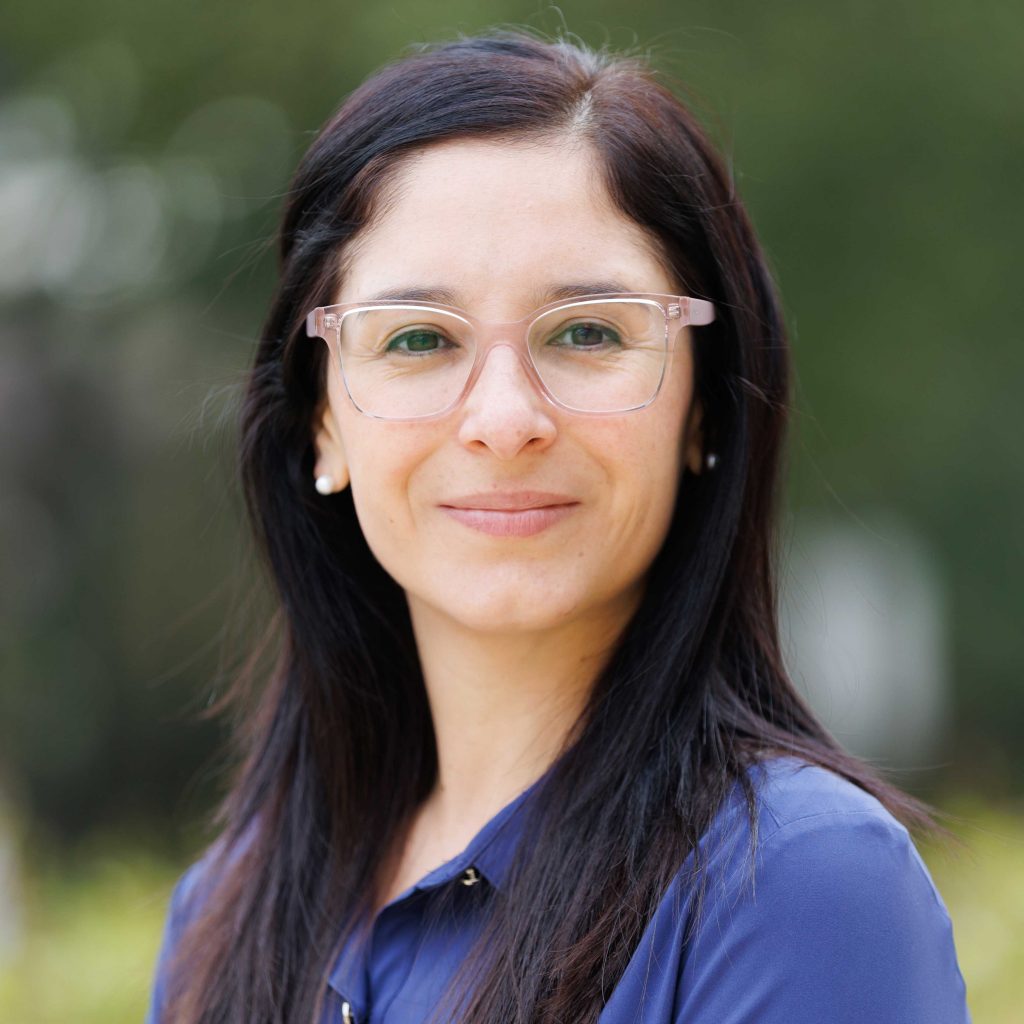
Dr. Macarena Suárez Pellicioni is an Assistant Professor in the Department of Educational Studies in Psychology, Research Methodology, and Counseling at The University of Alabama, where she directs the Brain, Learning, and Education Laboratory. Her research integrates behavioral, psychophysiological, and neuroscience approaches to examine the individual differences and neurocognitive mechanisms that support mathematical learning in children and adults.
Dr. Suárez Pellicioni earned her Ph.D. in Psychology from the University of Barcelona, where she received the Extraordinary Ph.D. Award for her dissertation. She completed postdoctoral training at The University of Texas at Austin and Vanderbilt University, specializing in pediatric fMRI and longitudinal neuroimaging. Her work examines how children develop arithmetic fluency, how brain systems involved in quantity processing and verbal retrieval support math learning, and how cognitive, affective, and social factors shape mathematical performance. To date, she has authored 30 peer-reviewed publications spanning behavioral, neuroimaging, educational, and review-based research.